Salem
Salem, Massachusetts, is the native town of the narrator and the primary setting of The Scarlet Letter, a place whose physical dreariness and deep ancestral roots create a powerful, ambivalent attachment in the author and provide the historical and moral landscape for Hester Prynne's story.
Physical and Historical Character
Salem is described as a town with a flat, unvaried surface covered chiefly with wooden houses that pretend to no architectural beauty, its long and lazy street lounging wearisomely through the whole extent of the peninsula, with Gallows Hill and New Guinea at one end and a view of the alms-house at the other. The narrator, who was born there, finds it as reasonable to form a sentimental attachment to such a place as to a disarranged checker-board. Yet the town possesses a hold on his affection, a feeling he attributes to the deep and aged roots his family has stuck into the soil. The earliest emigrant of his name, a grave, bearded, sable-cloaked, and steeple-crowned progenitor, made his appearance in the wild and forest-bordered settlement nearly two centuries and a quarter before the narrator's time. This ancestor was a soldier, legislator, judge, and a ruler in the Church, possessing all the Puritanic traits, both good and evil, and was a bitter persecutor of Quakers. His son inherited the persecuting spirit and made himself conspicuous in the martyrdom of the witches, leaving a stain of blood upon him. The narrator, as their representative, takes shame upon himself for their sakes and prays that any curse incurred by them may be removed. For above a hundred years, the family followed the sea, with a grey-headed shipmaster in each generation retiring from the quarter-deck to the homestead while a boy of fourteen took the hereditary place before the mast.
The Narrator's Connection and the Custom-House
The narrator felt it almost a destiny to make Salem his home, so that the mould of features and cast of character which had always been familiar there might still be seen and recognised in the old town. Nevertheless, he believed this very sentiment was evidence that the connection, which had become an unhealthy one, should at last be severed, comparing human nature to a potato that will not flourish if planted and re-planted for too long in the same worn-out soil. It was chiefly this strange, indolent, unjoyous attachment for his native town that brought him to fill a place in Uncle Sam's brick edifice, the Custom-House of the port, when he might as well have gone somewhere else. The Custom-House, a spacious edifice of brick with a view of a dilapidated wharf, was where he served as Surveyor of the Revenue. The discovery of a small package containing a scarlet letter and an explanatory manuscript by the old Surveyor, Jonathan Pue, provided the groundwork for the tale of The Scarlet Letter. The narrator, after his involuntary withdrawal from public life, opened his long-disused writing desk and was again a literary man, bringing the lucubrations of his ancient predecessor into play.
Salem as the Setting for the Narrative
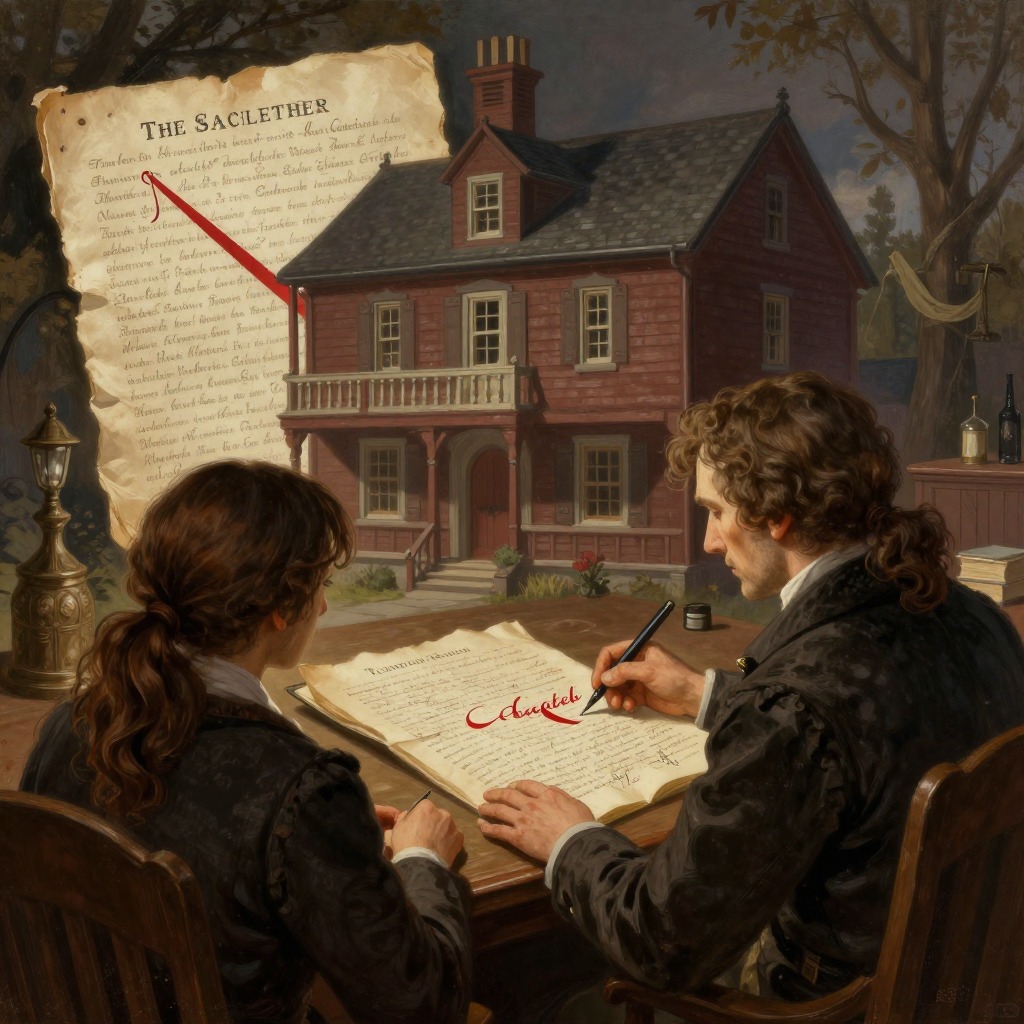
The story of Hester Prynne is set in Boston, not Salem, but the narrator's experience in Salem and his discovery of the scarlet letter there frame the entire narrative. The town of Salem itself, with its history of Puritan severity and its decaying commercial life, serves as the lens through which the narrator approaches the tale. The Custom-House, with its row of venerable figures, its old Inspector, and its gallant old General, represents a mode of life that the narrator found both wearying and instructive. The narrator's reflections on his own family's history in Salem, including the persecuting spirit of his ancestors, establish a moral and historical context for the story of sin, punishment, and redemption that follows. The town's physical aspect, its long and lazy street, and its chill east wind contribute to the sombre atmosphere that pervades the novel. The narrator's final thought, that the great-grandchildren of the present race may sometimes think kindly of the scribbler of bygone days, ties his own literary efforts to the enduring memory of Salem.